At first, it seems that OMP is the routing protocol of the whole SD-WAN network. But is it? Does OMP route traffic from one end host to another? You know by now that this is not exactly true.
OMP is only the routing protocol of the SD-WAN overlay. Its job is to connect edge routers through the centralized vSmart controller. But most sites are not just edge routers. They are LAN networks with switches, routers and firewalls that often run a traditional routing protocol such as OSPF, EIGRP, RIP, or BGP. Therefore, OMP connects separate site-local routing domains together via redistribution like Local LAN Rouitng->OMP->Remote LAN routing and vice-versa.
And what happens whenever there is redistribution? There is always a risk of a routing loop. A route can enter the site from OMP, get advertised into the LAN, and then be learned by another edge router at the same site. What if that second edge advertises the same route back into OMP? That is the loop condition for you, as shown in the diagram below.
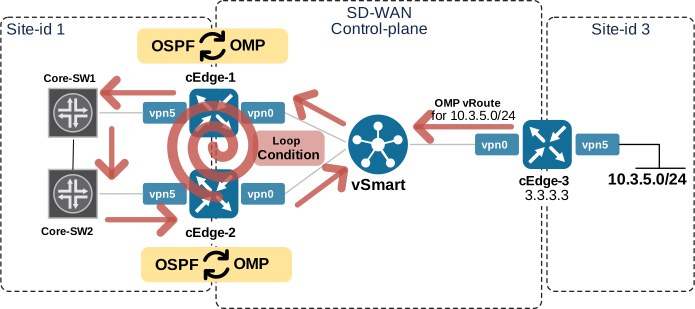
This chapter explains how loop prevention works for each site-local routing protocol. As we go through the examples, keep one detail in mind: OMP connects sites together, but site-local routing connects devices inside the LAN. The boundary between the two is where redistribution happens. And wherever there is redistribution, there is always a risk of routing loops.