© 2026 by Ivan Iliev Ivanov. All rights reserved.
No part of this publication may be reproduced, distributed, stored in a retrieval system, or transmitted in any form or by any means, electronic, mechanical, photocopying, recording, or otherwise, without the prior written permission of the copyright owner, except as permitted by applicable copyright law.
This book is provided for educational and informational purposes only. The book is designed to provide accurate and authoritative information in regard to the subject matter covered. It is sold with the understanding that the author and publisher are not engaged in rendering legal, accounting, or other professional services. If legal advice or other expert assistance is required, the services of a competent professional should be sought.
The author has taken great care in preparing this book. However, he makes no representations or warranties of any kind, express or implied, with regard to the completeness or accuracy of the contents of this book and specifically disclaims any implied warranties of merchantability or fitness for a particular purpose. The author and publisher shall have no liability to any person or entity with respect to any loss or damage arising from the information contained in this book.
Trademark acknowledgment: Cisco, CCIE, CCNP, CCNA, IOS, IOS-XE, Cisco Catalyst SD-WAN, Viptela, vManage, vSmart, vBond, vEdge, SD-WAN Manager, SD-WAN Validator, SD-WAN Controller, and other Cisco trademarks are the property of Cisco Systems, Inc. and are used herein for identification purposes only. This book is not sponsored, authorized, or endorsed by Cisco Systems, Inc or its partners.
All other trademarks and registered trademarks mentioned in this book are the property of their respective owners. The use of any trade name or trademark is for identification and reference purposes only and does not imply any association with the trademark holder or their product or brand.
Published by Ivan Iliev Ivanov, Independent Author
ISBN: 9798258638502
WARNING AND DISCLAIMER
SD-WAN: Example-based Study Guide is an independent publication and is not affiliated with, endorsed by, sponsored by, or approved by Cisco Systems, Inc., or any of its affiliates, partners, or any other entity. All opinions expressed in this book are the author's own and do not necessarily reflect the views of Cisco or its partners. The book is based on the author's personal experience and research and is intended to be used as a study resource and reference for learning about Cisco SD-WAN technology.
The primary purpose of this book is to serve as a study resource for individuals who are interested in learning about Cisco SD-WAN and preparing for related certification exams. While this book provides detailed explanations and examples of various Cisco SD-WAN concepts and configurations, it is important to note that it is not an official Cisco publication, technical manual, configuration guide, or professional services document. Readers should always consult the applicable official vendor documentation, release notes, product manuals, and qualified technical professionals before deploying, modifying, or relying on any configuration, design, or procedure in a production environment.
The examples and lab exercises included in this book are intended to provide readers with practical experience and help them better understand the concepts covered in the book. However, the author cannot guarantee that the configurations presented in this book work in all environments, and readers are encouraged to use their own discretion and expertise when implementing SD-WAN configurations. Networking environments vary, and the results described in this book may not be achieved in all circumstances.
Use of any information, configuration, command, design approach, or recommendation contained in this book is at the reader’s own risk. To the fullest extent permitted by applicable law, the author disclaims all liability for any loss, damage, cost, or expense of any kind arising out of or related to the use of, or reliance on, the information contained in this book, including without limitation any direct, indirect, incidental, consequential, special, exemplary, or punitive damages.
By using this book, the reader acknowledges and agrees that sole responsibility for the evaluation, implementation, and operation of any network configuration or design remains with the reader or the reader’s organization.
The author's goal is to provide readers with a clear understanding of SD-WAN concepts and configurations and to help them develop the skills and knowledge needed to succeed in the field of networking.
GOALS AND METHODS
The CLI vs the GUI
This book uses the CLI for most hands-on configuration examples. Yes, the CLI is old. Yes, it is less scalable. But it is also the best way to truly understand how the solution works.
I know that in real production networks, changes are made in the vManage GUI and then pushed to vSmart and cEdge devices through NETCONF. That is the normal operational model. However, for me, the CLI is the foundational layer for understanding features and capabilities. The GUI is the scaling and compliance layer built on top of it. You cannot start directly from the GUI and expect to build strong fundamentals, because the GUI hides too much of the actual feature logic.
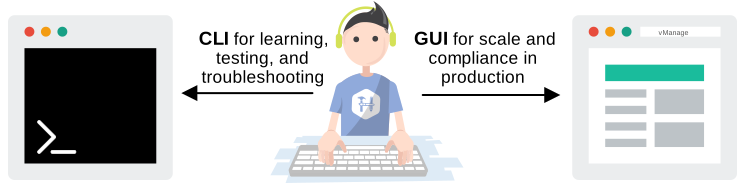
When you configure features directly on the devices, you see the logic behind them much more clearly. You learn not only how to enable a feature, but also how it works, how to verify it, and how to troubleshoot it. That gives you a much stronger foundation than simply clicking through menus in the GUI. Once you master the fundamental concepts, the GUI starts making sense and becomes easy to learn.
Controller Names
Notice that the official Cisco Catalyst SD-WAN controller names have changed from vManage, vSmart, and vBond to Manager, Controller, and Validator in release 20.12.1/17.12.1.
However, in this book, I mostly stick to the legacy controller names: vManage, vBond, and vSmart. I do it to avoid confusion. These controllers have been using these names for years, and that is how you will still see them in real networks. The CLI outputs, logs, and all troubleshooting commands continue to use the original names (vmanage / vbond / vsmart).
The newer names, such as Manager, Validator, and Controller, may make sense from a product branding perspective, but in practice, they can create confusion, especially when you are trying to match theory with actual device output, which still uses the old names.
Bold and Highlighted Text
Throughout this book, you will notice that I sometimes use bold text, italics, and color highlights to draw attention to specific details or emphasize important ideas. I understand that this may not be everyone’s favorite style, and I want to say that honestly from the very beginning.
I chose this approach based on my own experience writing articles, blog posts, online lessons, and technical books. Over time, I noticed that many people find it hard to stay focused on long blocks of technical text. This is the result of modern technologies. People are overwhelmed with text and other visual information every day, so their brains adapt by simply immediately forgetting what they just read. That’s why I often include these highlights in different colors and with bold or italic text. It serves as a stimulus to the brain, and most people tend to pay attention for longer and focus more deeply.
Of course, no single method works well for every reader. If this approach does not suit you, I sincerely apologize. And if the book is not a good fit for your learning style, please remember that the paperback comes with a 30-day return policy.
Writing by Hand
There is one more habit that I strongly recommend while reading this book: keep a notepad and a pen next to you and write things down by hand. Draw the topology. Write the terms. Sketch the packet flow. Rephrase the idea in your own way. This may sound old-fashioned, but it works.
Reading alone is often not enough. You may feel that you understand a topic while reading, but a few hours later, the knowledge is gone. Writing by hand forces your brain to process the concept, not just look at it. When you draw a diagram or write a few key notes yourself, the topic becomes more real and much easier to remember.
This is especially true in networking. Networking is full of cause-and-effect logic. A quick hand-drawn diagram often teaches more than a whole page of text. When you sketch how controllers connect, how routes move, or how policies affect traffic, you begin to see the system as a whole. You see the concept. That is when real understanding starts.
Personally, I use an e-paper notepad with a pen and write notes and diagrams by hand. I do this almost every night before bed. I have found that this helps me think more clearly and remember more the next day. The tool itself does not matter much. Paper is the best by a mile. An electronic notepad is also great. What matters is that you write by hand. That you activate the brain.
So, as you go through this book, do not just read passively. Pause often. Write small notes. Approach concepts from different angles. Draw simple diagrams. Mark the ideas that confuse you. Then redraw them again in a simpler way.
In the age of AI, be human. Learn the human way.
DEDICATION
This book is dedicated to my family, friends, and colleagues for their support throughout my writing journey.
With this book, I want to send a message to all people who, like me, at some point, have found themselves caught in the endless loop of mindless consumption of news feeds, doom scrolling, and social media.
Think about the effort we put into protecting our material things from theft. We lock our houses, have security in place, have insurance, have a bank to protect our money, etc. We understand the value of our possessions and take steps to protect them from theft.
Now think about how little effort we put into protecting our most valuable resource - our time. Without proper protection, companies such as news sites and social media steal our time, leaving us consuming instead of creating.
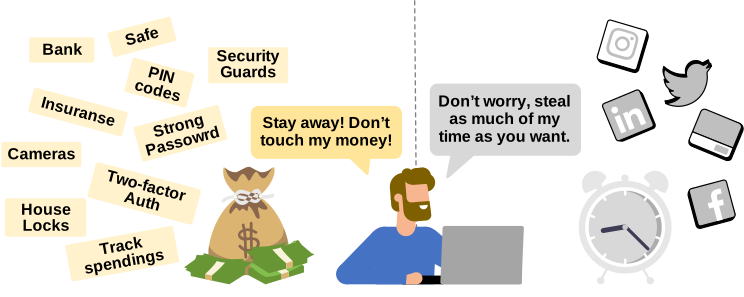
But I believe we can do better. Imagine what we could accomplish if we spent just an hour a day creating something instead of consuming news and social media. We could write that book we've always dreamed of, build that app, take that challenging certificate, or create that blog that inspires others. Extraordinary results are built through small, ordinary efforts day after day. But when our time is constantly drained, we are left with no energy to do things that truly matter.
So, this book carries a simple message - protect your time, consume less, and create more.
Good luck and stay healthy!
Ivan Ivanov