I have been a network engineer for twenty-plus years. Since you are reading this lesson, you are most likely a network engineer too. Network engineers have one thing in common: they don't want to switch professions, especially to become software or platform engineers.
So as long as this profession exists, we network engineers will be network engineers. And I believe networking will exist long after AI disrupts most of IT. Why? Because the network sits at the crossing point of multiple IT domains:
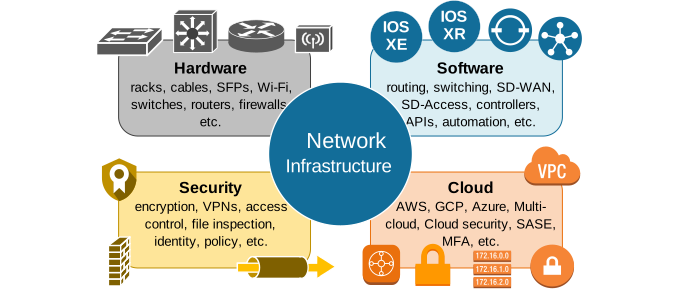
- It touches hardware: racks, cables, SFP modules, Wi-Fi, switches, routers, and firewalls.
- It touches software: routing protocols, switching protocols, SD-WAN, SD-Access, controllers, APIs, and automation platforms.
- It touches security: encryption, VPNs, access control, file inspection, remote access, and policy.
- It also touches cloud, containers, identity, monitoring, and operations.
- And it is also one of the basic ingredients of governance and sovereignty.
For me, the network is like a country’s road system. There are many vehicle brands and models. Cars, trucks, buses, and motorcycles are all different. But once they use the road, they must follow the same rules.
The road infrastructure enforces order.
The network plays the same role in an organization. There will be users, bots, agents, applications, containers, AI workloads, and so on. They may all be different. But once they communicate, they must follow the organization’s rules. Who can talk to whom? Which traffic is allowed? What must be encrypted, inspected, blocked, or logged?
This is why the network is more than connectivity. It is where policy, security, visibility, governance, and sovereignty take place.
So I cannot imagine a world where AI handles everything on its own. Who will rack the equipment? Who will replace a failed SFP? Who will trace a cable? Who will understand the business risk behind a network change? And most importantly, who will enforce the order - what these AI bots can access and what they cannot?
I think this will be the network. Especially with modern segmentation and identity capabilities such as Cisco ISE and SGT, every user in the network (real person or an agent) will be assigned an identity and tracked and controlled at all times by the network.
Why should I learn network automation?
The network domain is so vast you cannot know everything. You need to specialize in some sub-domain such as datacenter, service provider, wireless, or security. These are the certification tracks you can choose to pursue. These CCNP/CCIE tracks make you a deeper network engineer.
However, CCNP/CCIE changes your profile completely.
You start to understand software development, APIs, task pipelines, and how systems work together. This gives you a much broader context to work with.
And that matters more than ever. Why? Because at the moment, AI chatbots are only as useful as the person guiding them.
Why should I learn Python?
So I think that networks will be around for many more years to come. I even believe that networking will be even more important in the age of AI, because it will become the place where you monitor and control what AI agents and bots do.
Now, let's go back to network automation and more specifically Python. Let's not pretend that AI doesn't exist. AI already writes quality code in any programming language. That's why people often ask: Why learn a programming language when AI can write the code for me?
The answer is simple: AI makes Python knowledge more valuable, not less valuable.
Yes, AI can write code. But you still need to understand the business. You must understand the network. You must also understand code. You must describe the task, provide the correct limits, review the result, test the code, and decide whether it is safe to use and whether it solves the problem at hand or not.
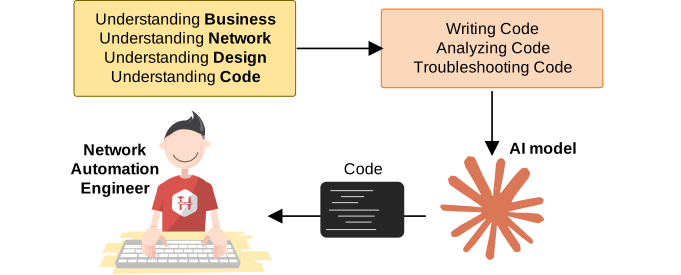
AI can automate many tasks, but it cannot replace network automation. It is a tool.
AI Is a Leverage Tool
I always think about AI as a leverage tool. It is the same as all other leverage tools. Leverage allows you to achieve larger output from the same effort. For example:
- A crane gives a builder leverage.
- A tractor gives a farmer leverage.
- A search engine gives a researcher leverage.
AI gives knowledge workers leverage.
However, leverage does not replace skill. It increases the effect of the skills that you already have.
For example, AI can write code. But can I write a new Operating System like Windows or MacOS with AI alone? Absolutely not. I don't have the architecture, design, programming, etc. knowledge to even know where to start.
AI has been around for 3-4 years already, and I haven't seen any new operating systems come out.
AI has read all medical books and medical scientific papers. But can I become a doctor using AI? Absolutely not.
AI is a leverage tool that makes you tens or hundreds of times more productive and efficient in your field. But you have to be an expert in your field in the first place. Some people want to use AI to cut corners or find excuses that they don't need to constantly learn. But the reality is that you need to constantly try to be a better professional in your field. And AI will naturally become a leverage for you.
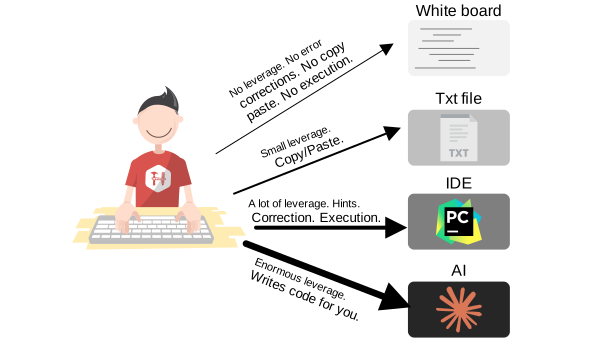
An experienced network engineer can use AI to create a first version of a Python script, review it, test it, correct it, and adapt it to the real environment. This may reduce hours of work to minutes.