LAB 2 - Controlling the topology with restricted TLOC Colors
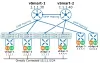
In the previous lab lesson, we have seen how we can connect a vEdge router to the WAN transport attached to the adjacent vEdge router using a feature called TLOC Extension.
In the previous lab lesson, we have seen how we can connect a vEdge router to the WAN transport attached to the adjacent vEdge router using a feature called TLOC Extension.
One of the most common use-cases for localized control policies is manipulating the local routing advertisements so that site-local routers prefer one vEdge over another in a dual-homed environment.
The main difference between centralized and localized policies is the area of effect. A centralized policy is applied on vSmart and has a network-wide impact (hence centralized).
The fundamental goal of every network is to provide continuous network service by rerouting around failures and potential causes of downtime. Cisco SD-WAN achieves high availability through a combination of four principles:
In Traditional WAN networks, routers make forwarding decisions based primarily on link-state and routing metrics. Cisco SD-WAN allows us to configure SLA-based routing that considers performance characteristics such as packet loss, latency, and jitter when making forwarding decisions.
In this lesson, we are going to go through a high-level overview of the most common Cisco SD-WAN Cloud onRamp designs when it comes to integration with Amazon Web Services (AWS).